

China’s traffic doesn’t work like the US or Europe. You need a Chinese license, not an IDP. WeChat Pay is mandatory for parking. Google Maps won’t load. And lanes? They’re suggestions, not rules.
This guide covers:
- Lane discipline (or lack of it) and what foreigners get wrong
- No-honking zones and when you actually need to honk
- Legal requirements to drive as a foreigner
- Pedestrian survival tactics
- City-by-city differences in Beijing, Shanghai, Guangzhou, Shenzhen
- Real hazards: e-bikes, construction debris, night driving
Lane Discipline: Forget What You Know
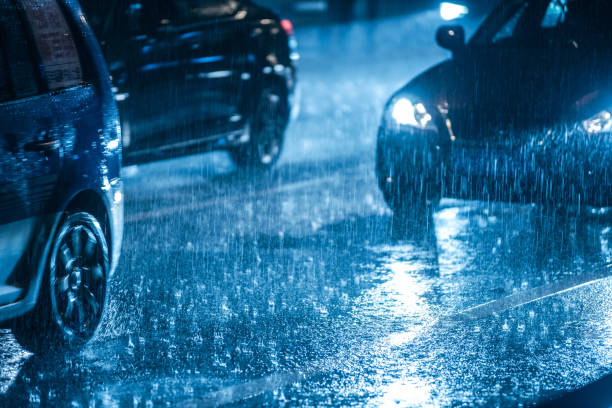
Lanes in China are not private property. Drivers change lanes 0.83 to 1.04 times per vehicle-kilometer on freeways—double the 0.4-0.5 rate on Dutch highways, according to research on Chinese freeway behavior. This happens because drivers aggressively chase small speed gains, not because they’re reckless.
Western drivers fixate on staying in their lane. In China, you’ll see motorcycles, bicycles, pedestrians, and delivery e-bikes in car lanes without warning. Painted lines exist, but enforcing them would gridlock the city.
68% of lane changes on intercity highways fit “aggressive” patterns—drivers take gaps under 2-3 seconds. The entire maneuver lasts 15-30 seconds, per the same freeway study. If you’re used to the US, where people signal 100 feet ahead and check mirrors twice, you’ll misjudge these moves and cause a rear-end collision.
Expat Matthew Bossons, who drove across China, put it this way: “In China, lanes are not private property and there is no such thing as ‘personal space’ even on the roads. Such an intrusion is expected at all times.” Read his full account of adapting to Chinese driving.
What Foreigners Get Wrong
- Expecting lane ownership. You will be cut off. Constantly. Don’t take it personally.
- Not scanning mirrors. Check left, right, and rear every 10 seconds. Motorcycles appear from blind spots.
- Trusting turn signals. Many drivers don’t use them. Watch the front wheels of adjacent cars to predict lane changes.
- Assuming pedestrians stay on sidewalks. They don’t. Expect them in the road, especially near markets or bus stops.
The right lane sees the highest lane-change rate (up to 0.95 per vehicle-km near on-ramps) because drivers dodge trucks or merge toward faster median lanes, per the PLoS ONE study.
No-Honking Zones: When to Honk, When You’ll Get Fined

The horn is not rude in China—it’s a communication tool. Drivers honk to say “I’m here” before passing, merging, or entering a blind intersection. Unlike in the US, where honking implies anger, it’s neutral here.
But no-honking zones exist. Look for signs with a crossed-out horn symbol (禁止鸣笛). These zones cover residential areas, schools, and hospitals. Shenzhen banned all non-emergency honking citywide in 2023, including police and ambulances, as part of a noise crackdown (source).
Shanghai uses acoustic cameras to catch violators, issuing fines up to 100 yuan (about $16 USD). Traffic official Wei Kairen explained the goal: “The first [aim] is a quieter city — so fewer car horns. We have established and enforced ‘no-blaring zones’ and clamped down on illegal horn use.” The effort worked—fewer violations after a year of strict policing, according to Sixth Tone’s report on Shanghai’s traffic overhaul.
When to Honk Anyway
In dense traffic outside no-honking zones, you need to honk. A short tap alerts merging cars or e-bikes that don’t check mirrors. A longer blast warns pedestrians stepping into the road without looking.
Foreigners make two mistakes:
- Under-honking in chaotic traffic. They assume others will follow rules and check mirrors. They won’t.
- Over-honking in quiet zones. They get fined because they didn’t notice the sign.
Legal Requirements to Drive in China
You cannot drive in China with a US, UK, or Australian license alone. You cannot use an International Driving Permit (IDP). China doesn’t recognize either.
You need a Chinese driver’s license or a temporary permit.
Temporary License for Short-Term Visitors
The Chinese Temporary Driver’s License Service processes in as little as 10 minutes, depending on location. Valid nationwide for Category C vehicles (small passenger cars). No theory exam or road test required. You need:
- Your foreign driver’s license
- Official translation and notarization of that license
- Passport with valid visa
Good for business travel, tourism, family visits. Processing starts at 10 minutes. Source: China Legal Experts on driving licensing.
Long-Term License (Conversion from Foreign License)
The China Driver’s License Conversion Service costs USD 500. You take only the Subject 1 theory exam—100 multiple-choice questions available in nine languages, including English. No road test. No driving school. Resulting license valid 6-10 years nationwide for Category C.
If you don’t have a foreign license, the China Driver’s License Exam Service costs USD 2,600, includes exam booking and theory prep, and takes as little as 15 days. Grants a 10-year nationwide Category C license. Details from China Legal Experts.
What You’ll Need for the Theory Exam
Subject 1 covers traffic signs, right-of-way rules, speed limits, and penalties. Study apps exist in English. The exam is administered on a touchscreen computer at the local vehicle administration office (车管所, chēguǎnsuǒ). You need 90/100 to pass.
Bring:
- Passport
- Residence permit (for long-term license)
- Translated and notarized foreign license
- Passport-sized photos (white background)
- Health certificate from an approved clinic (vision and physical check, takes 30 minutes, costs around 50-100 yuan)
Google “车管所” + your city name in Chinese to find the office. Amap (Gaode) will navigate there—Google Maps doesn’t work in China without a VPN.
Traffic Law Enforcement: Cameras Everywhere
China uses automated traffic cameras that issue fines for running red lights, illegal lane changes, speeding, and crossing solid white lines. You won’t see a cop pull you over—you’ll get a text or app notification days later.
Common violations foreigners miss:
- Running a red light: 6 demerit points, 200 yuan fine
- Improper lane change (crossing solid white line): 3 points, 200 yuan
- Ignoring one-way street signs: 3 points, 200 yuan
- Speeding 10-20% over limit: 3 points, 200 yuan
China’s 12-point demerit system caps at 12 points per year. Lose all 12 and your license is suspended. You retake the theory exam to reinstate it.
Pedestrians have right-of-way at marked crossings, even if you have a green light. Cameras enforce this. Failing to yield costs 3 points and 200 yuan.
Pedestrian Survival: Never Assume Right-of-Way
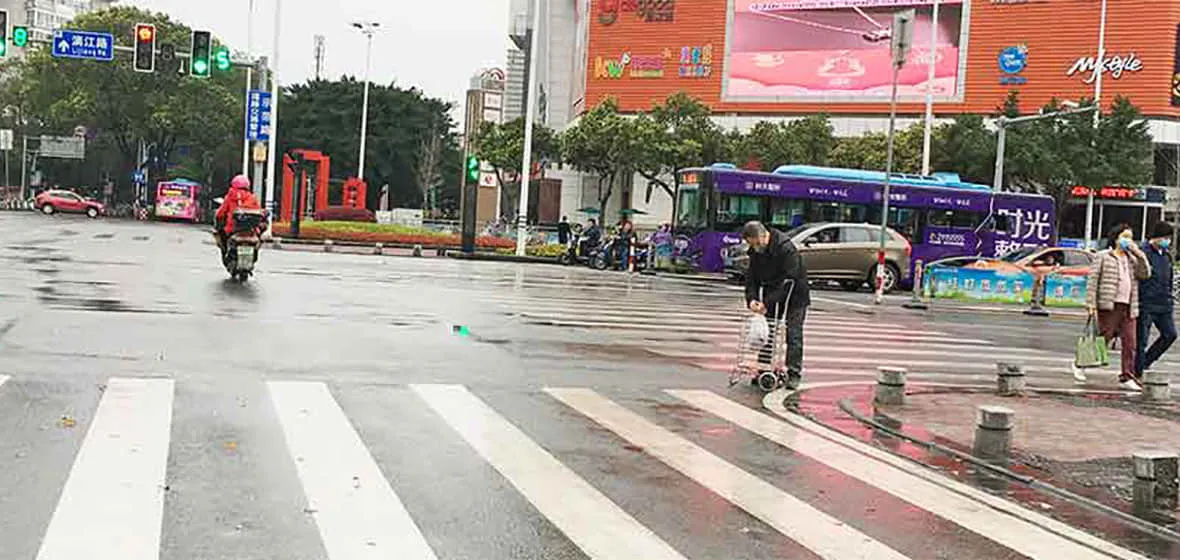
Crosswalks and green lights do not guarantee safety. Drivers rarely stop unless you’re already in the road. E-bikes and scooters run red lights silently.
How to Cross a Street in China
- Wait for a group. Drivers hesitate more when facing multiple pedestrians.
- Look left, right, left again. Then keep looking while crossing.
- Make eye contact with drivers. If they’re looking at their phone (common), assume they won’t stop.
- Cross during a gap in traffic, not during a green light. The light just means cars should stop. They often don’t.
E-bikes and electric scooters are silent. They approach from behind or weave through stopped cars. Always scan 360 degrees before stepping into the road.
Public Transportation: You Need WeChat or Alipay
Metros and buses don’t take cash in most cities. Credit cards (Visa, Mastercard) don’t work on turnstiles.
Set up WeChat Pay or Alipay before you arrive:
- Download the app
- Link an international credit card (some banks block this—try multiple cards)
- Or deposit cash at a bank counter and scan a QR code to load your balance
Alternatively, buy a rechargeable transit card (交通卡, jiāotōngkǎ) at metro station kiosks. Costs 20-30 yuan deposit plus your initial load (50-100 yuan). Works on metros and most buses. Refundable when you leave.
Metro stations display signs in English in major cities (Beijing, Shanghai, Guangzhou, Shenzhen). Announcements are bilingual. Smaller cities (Chengdu, Xi’an, Hangzhou) have less English—use the Amap app to confirm your stop in Chinese characters.
Peak hours (7:30-9:00 AM, 5:30-7:30 PM) are packed. Guard your belongings. Pickpockets target distracted tourists.
City-by-City Differences

Beijing
Aggressive driving at low speeds. Average traffic speed is 18 km/h during rush hour. The ring road system (2nd Ring, 3rd Ring, up to 6th Ring) confuses newcomers—use Amap for navigation.
E-bikes dominate. They ignore red lights, ride on sidewalks, and merge into car lanes without warning. Beijing traffic police rarely enforce e-bike violations.
No-honking zones exist near schools and hospitals, but enforcement is inconsistent compared to Shanghai. Expect frequent horn use elsewhere.
Shanghai
Stricter enforcement. Shanghai’s “Big Traffic Overhaul” reduced illegal horn use through sustained fines and acoustic cameras (Sixth Tone report). No-honking zones are taken seriously—budget for fines if you ignore signs.
Elevated highways crisscross the city. Lane discipline is slightly better than Beijing, but still fluid. Drivers use turn signals more often (still only 60-70% of the time).
Cameras are everywhere. You’ll get fined for minor infractions that Beijing ignores.
Guangzhou and Shenzhen
Fast-paced traffic. Motorcycles are banned downtown in both cities, so expect cars and e-scooters. Shenzhen’s total honking ban (as of 2023) means silence in the city center—use your horn and you’ll get fined immediately (source).
Guangzhou traffic feels more predictable than Beijing. Lane changes are aggressive but follow patterns—drivers signal slightly more often, and gaps close more slowly.
Shenzhen is tech-heavy. Expect electronic toll collection (ETC) on highways. Set up an ETC account through WeChat or Alipay before entering toll roads, or you’ll wait in long cash lanes.
Common Hazards

E-Bikes and Scooters
Electric bikes and scooters are silent, fast (up to 40 km/h), and operate without license plates or insurance in many cities. They run red lights, ride against traffic on one-way streets, and cut across multiple lanes without signaling.
Assume an e-bike will appear in your blind spot at any intersection. Check mirrors before every turn. At night, many lack working lights—scan aggressively with your high beams in low-traffic areas.
Construction Debris and Potholes
Uncovered manholes, loose bricks, and construction equipment appear on roads without warning cones. This is common on secondary roads and in older neighborhoods.
Drive slowly in unfamiliar areas. Potholes can blow a tire—Chinese roads use different asphalt standards, and repairs are inconsistent.
Roadside Parking Traps
Parking enforcement uses cameras and roving attendants. If you park illegally, you’ll get a ticket (200 yuan, 3 points). If you block traffic, your car gets towed.
Pay for parking through WeChat or Alipay by scanning a QR code on the parking sign. Cash and credit cards don’t work. If there’s no QR code, find the attendant (usually wearing a vest, sitting nearby). They’ll write a paper ticket with a QR code to scan.
Night Driving
Poor lighting on secondary roads. Some vehicles drive without headlights (burned-out bulbs are common on older trucks). Pedestrians wear dark clothing and cross against lights.
Use high beams outside the city center. Flash your lights at oncoming traffic if they’re blinding you—they’ll usually dip their beams.
E-bikes and bicycles often lack reflectors or lights. Slow down near bus stops, markets, and residential entrances where pedestrians gather.
Defensive Driving: Assume Nobody Follows Rules

Expat drivers who survive Chinese roads adopt one mindset: “Assume nobody else is going to follow the rules.” This is not cynicism—it’s survival. From Far West China’s driving guide, experienced drivers recommend:
- Scan mirrors every 10 seconds. Motorcycles and e-bikes appear without warning.
- Watch front wheels of adjacent cars. Wheels turn before the car does. Ignore turn signals—watch the wheels.
- Expect pedestrians anywhere. Crosswalks don’t confine them. Scan sidewalks for people about to step out.
- Leave double the following distance. Cars brake suddenly for no visible reason (avoiding potholes, debris, or pedestrians you didn’t see).
- Honk before passing. A short tap warns the car ahead. Don’t assume they checked mirrors.
When changing lanes, one expat described the tactic: “No matter how much eye contact and smiling there is, people will not let you in, so you have to nudge your way into gaps.” This comes from a China Daily interview with a long-term foreign driver. You signal, ease into the gap, and force adjacent cars to react. Hesitation creates accidents—commit or stay in your lane.
Frequently Asked Questions

Can foreigners drive in China with an International Driving Permit?
No. China doesn’t recognize IDPs. You need a Chinese driver’s license or temporary permit.
What should pedestrians do if there is no crosswalk or traffic signal?
Find the clearest sightline in both directions. Wait for a large gap in traffic. Cross quickly. Do not assume cars will slow down.
How strictly are no-honking zones enforced in Chinese cities?
Varies by city. Shanghai and Shenzhen enforce aggressively with acoustic cameras and fines (Sixth Tone source). Beijing enforcement is inconsistent. Always check for signs.
What are the penalties for running a red light in China?
6 demerit points and 200 yuan fine, enforced by traffic cameras. Accumulate 12 points and your license is suspended.
How do I pay for public transportation as a visitor in Chinese cities?
Use WeChat Pay or Alipay (link an international card before arrival). Or buy a rechargeable transit card (交通卡) at metro kiosks for 20-30 yuan deposit.
Is it safer to hire a local driver than drive myself as a tourist?
Yes, for short-term visitors. Local drivers know road conditions and traffic culture. Private Driver Coordination service available from RMB 600/day. Eliminates licensing hassle and lets you focus on sightseeing.
Check your tire pressure weekly. Chinese roads tear up tires faster than Western highways due to debris, potholes, and frequent hard braking. Keep pressure at the manufacturer’s recommended PSI (check the sticker inside the driver’s door). Underinflated tires blow out on highway on-ramps where aggressive merging forces sudden speed changes.
Sources:
- https://journals.plos.org/plosone/article?id=10.1371/journal.pone.0191466
- https://www.chinaxiantour.com/travel-guide/driving-in-china
- https://factsanddetails.com/china/cat13/sub86/entry-8365.html
- https://global.chinadaily.com.cn/a/202301/30/WS63d79b1ca31057c47ebabe1c.html
- https://www.sixthtone.com/news/2023/1000474/the-surprise-about-shanghais-traffic-crackdown-its-working
- https://www.travelchinawith.me/china-facts/chinese-traffic-rules/
- https://www.chinalegalexperts.com/news/driving-in-china-licensing-traffic-rules
- https://www.farwestchina.com/blog/how-china-taught-me-to-drive-better/
- https://www.chinadaily.com.cn/cndy/2007-09/14/content_6106159.htm
- http://www.npc.gov.cn/zgrdw/englishnpc/Law/2007-12/05/content_1381965.htm
- http://en.npc.gov.cn.cdurl.cn/2022-10/08/c_817695.htm
- https://www.globaltimes.cn/content/817920.shtml
- https://www.adventuresaroundasia.com/china-culture-shock-driving-in-china/